|
23-24 juin 2026 Bordeaux (France)
|
|
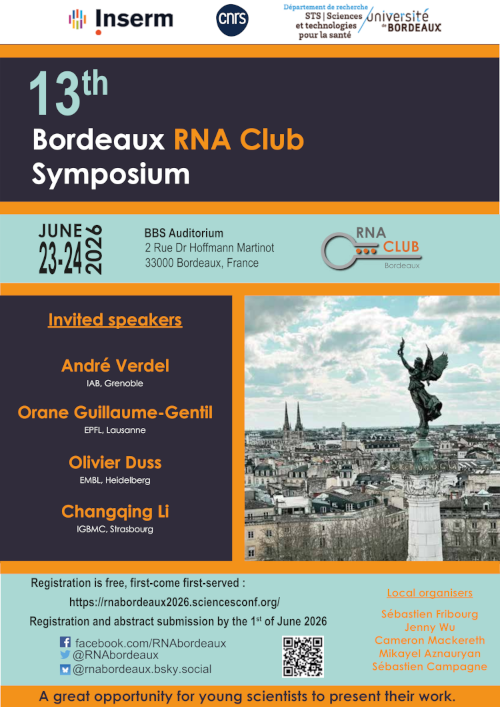
13th Bordeaux RNA Club Symposium Registration now open
Sponsors:
We are excited to announce that the call for abstracts for the upcoming 13th Bordeaux RNA Club is now open! This meeting will take place on June 23th (starting at 2:00 PM) and June 24th (ending at 5:00 PM) at the Amphitheater of the Bordeaux Biologie Santé building and will include talks from selected abstracts and a poster session. The Bordeaux RNA Club has become a classic in Bordeaux’s scientific agenda and will feature invited speakers presenting cutting-edge research across various areas of RNA biology, broadly ranging from RNA structure, processing, regulation and function to RNA in disease and therapy. It’s a fantastic opportunity for Master’s students, Ph.D. candidates, Postdocs, and Researchers at any stage of their careers to network and share their work just before the start of summer. Important dates: 01 June 2026 - Registration deadline 01 June 2026 - Abstract deadline Directions: The conference will take place in the auditorium of the BBS building on the Carreire Campus of the Univ. Bordeaux Bordeaux Biologie Santé (BBS), Rue Dr Hoffmann Martinot, 33000 Bordeaux https://maps.app.goo.gl/6q63KaoR6SEYKJHV7 The easiest way to get to the venue is by Tram. Take tram line A or line F to the 'Saint Augustin' stop, and then it is a 5 minute walk to the BBS building.
Accommodation: Many hotels are located along Tram lines A and F, with several hotel options in the area of Meriadeck
Preliminary schedule: Day 1 : Tuesday, June 23rd 14:00 – Welcome at the BBS auditorium 14:15 – Invited Speaker 15:00–16:00 – Oral presentations 16:00 – Coffee Break 16:30–17:15 – Oral presentations 17:15 – Invited Speaker 18:00 – End of Day 1 Day 2 : Wednesday, June 24th 09:30–10:30 – Oral presentations 10:30 – Coffee Break 11:00 – Invited Speaker 11:45–12:45 – Oral presentations 12:45 – Lunch & Poster Session 14:00–15:00 – Oral presentations 15:00 – Invited Speaker 15:45 – Farewell coffee 17:00 – End of Day 2
Invited speakers: André Verdel - Institute for Advanced Biosciences, Grenoble Title: YTH-mediated gene silencing across eukaryotes Abstract: YTH proteins are RNA-binding proteins (RBPs) that contain a structurally conserved YTH domain, which specifically recognizes N6-methyladenosine (m6A), the most abundant internal RNA modification. Through this interaction, YTH proteins regulate key processes such as chromatin modification, RNA maturation, degradation, and export, thereby modulating gene expression and influencing important biological processes including cellular differentiation, proliferation, and stress responses. Early biophysical and structural studies of the YTH domain’s ability to bind m6A led to the widespread assumption that this epitranscriptomic interaction is autonomous—that is, that the YTH domain alone is sufficient for m6A recognition and that its binding activity is not subject to regulation. However, I will present a series of findings from our group providing evidence that YTH–RNA interactions are regulated in yeast, plants, and humans. Our data show that YTH recognition of m6A is subject to regulation, which may fine-tune the sequence specificity and binding affinity of YTH domains for RNA. This regulatory mechanism has the potential to be widespread across eukaryotes. Orane Guillaume-Gentil - EPFL, Laboratory of Systems Biology and Genetics, Lausanne, Switzerland Title: Live-Seq: tracking gene expression in living single cells across time and space Abstract: Single-cell RNA sequencing has transformed our understanding of cellular heterogeneity, yet its destructive nature prevents longitudinal measurements in the same cell, limiting the direct study of dynamic processes. Olivier Duss - EMBL Heidelberg, Germany Title: Dynamic RNA biology at the single-molecule level: Watching how interconnected processes work in real-time Abstract: A central question in biology is how macromolecular machines function cooperatively. In the first part, I will show our recent work investigating how bacterial transcription and translation cooperate. We have reconstituted a complete and active transcription-translation system and developed multi-color single-molecule fluorescence microscopy experiments to directly and simultaneously track transcription elongation, translation elongation and the physical and functional coupling between the ribosome and the RNAP in real-time (Qureshi & Duss, Nature, 2025). A main finding is that the ribosome and the RNAP can communicate with each other by mRNA looping, providing an alternative explanation on how the ribosome can efficiently rescue RNAP from frequent pausing without requiring collisions by a closely trailing ribosome. In the second part, I will discuss how the bacterial rRNA transcription antitermination complex (rrnTAC) coordinates early co-transcriptional rRNA processing. By directly tracking rrnTAC assembly and co-transcriptional RNase III cleavage in real-time, we find that stable rrnTAC assembly is required to reduce RNAP pausing and to boost co-transcriptional rRNA processing. Our results reveal how transcription factor binding dynamics relate to function: transient for messenger RNA transcription and stable for rRNA transcription and processing. Changqing Li - IGBMC Strasbourg, France Title: Structure and function of the human TIP60/EP400 co-activator Abstract: The TIP60–EP400 complex (TIP60-C) is a 20-subunit assembly that plays a pivotal role in epigenetic regulation. It modulates chromatin structure through ATP-dependent exchange of histone H2A/H2B for H2A.Z/H2B, as well as through histone acetylation and lactylation. Beyond its canonical role as a transcriptional coactivator, TIP60-C acts as a key regulatory hub in DNA damage repair, cell-cycle control, autophagy, apoptosis, and immune defense through acetylation and lactylation of non-histone substrates. We report the high-resolution structure of endogenous human TIP60-C purified from CRISPR/Cas9-engineered cells expressing affinity-tagged EPC1. TIP60-C adopts a three-lobed architecture comprising SWR1-like (SWR1L) and NuA4-like (NuA4L) modules connected through a TRRAP-containing activator-binding module. The EP400 subunit forms the scaffold, traversing the interface between SWR1L and NuA4L and housing the ATPase motor. This arrangement structurally integrates ATP-driven histone exchange and lysine acetylation/lactylation, and in vitro assays show H2A.Z incorporation is stimulated by acetyl-CoA, indicating direct mechanistic coupling between the two activities. Ongoing studies further investigate the interactions of TIP60-C with nucleosomes and non-histone substrates. Together, our findings establish a molecular framework for understanding how TIP60-C regulates transcription and diverse cellular pathways, and how its dysregulation contributes to human disease. |